Cryptocurrencies - statistics & facts
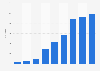
When Bitcoin launched in 2009, it was little more than a technical curiosity passed between cryptographers. By early 2026, cryptocurrency users worldwide were estimated to have reached 994 million. Almost one billion people, while the total crypto market capitalization stood at nearly four trillion U.S. dollars as of late 2025. Digital assets are no longer at the edge of finance. They are inside it, changing how capital moves, how payments are structured, and what money can mean.
Bitcoin's dominance in a fragmented market
While thousands of cryptocurrencies exist worldwide, many are insignificant, with Bitcoin and Ethereum holding a majority of the value. Bitcoin has commanded a market capitalization of 1,286.74 billion U.S. dollars as of July 16, 2026, outpacing every other leading digital asset worldwide by a considerable margin. Bitcoin's share of the market has hovered roughly near the 60 percent mark. Well over half of all capital invested in cryptocurrency flowing through a single asset, even as thousands of alternatives compete for attention. The number of cryptocurrencies has multiplied, but breadth has not translated into distribution of value.
Crypto goes global, but unevenly
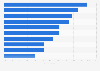
Adoption rates vary sharply across regions. Cryptocurrency ownership across individual countries showed South Africa leading at 25 percent, followed by Brazil at 23 percent. The United States registered 13 percent; Japan registered seven percent. For the most part economies with deep, established banking infrastructure are not driving this expansion. Economies where that infrastructure remains out of reach for large portions of the population are. That distinction matters for how regulators, developers, and financial institutions should think about who crypto actually serves.
A revenue recovery fueled by renewed confidence
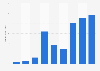
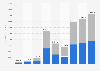
After contracting to 30.3 billion U.S. dollars in 2023, cryptocurrency revenue worldwide recovered to an estimated 80.7 billion U.S. dollars in 2024 and climbed further to 96.1 billion in 2026. That rebound exceeds the market's 2021 peak of 64.1 billion U.S. dollars by more than 50 percent, driven by a broader range of use cases spanning trading, decentralized finance, and digital payments. A single bad year did not define the trajectory.
Stablecoins and the road ahead
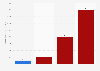
The global stablecoin transaction volume reached an estimated 250 billion U.S. dollars in 2025, with payment transactions accounting for roughly 15 billion U.S. dollars, or about 6 percent of total activity. Forecasts diverge in scale but align in direction: projections range from 500 billion U.S. dollars by 2028 to as high as four trillion by 2035. That range reflects genuine uncertainty about the pace of adoption, but not about the direction. Stablecoins are the most plausible mechanism for moving crypto from speculative asset to functional payment infrastructure, and the window for traditional financial institutions to set the terms of that transition is narrowing.